
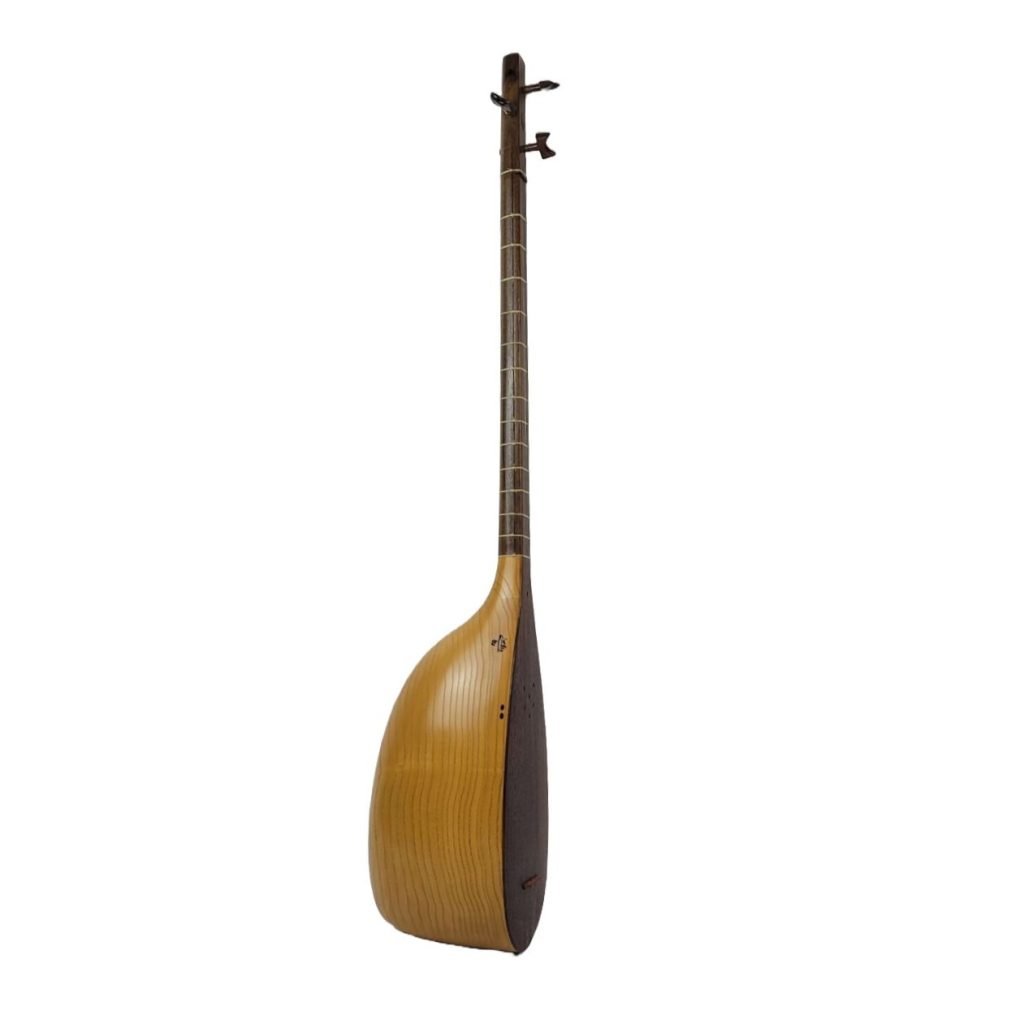
Tanbour is a sacred lute family instrument with spiritual and mystic sound characteristics. Different versions of Tanbour are played in countries such as Iran, India, China, Turkey, Japan, Afghanistan, Greece, etc.
- Tanbour is one of the most ancient instruments which has deep and valuable roots in human history and culture and is considered a precious heritage in the Kurdish community as well.
- In the Kurdish community, “Yaresan”s play not for Tanbour, but they consider it as a spiritual requirement to deliver their verses and poems to the audience.
- Sufis play Tanbour to accompany their poems and verses – called Kalaam. Tanbour has some ancient melodies – called Moqam – which accompany those Kalaams(verses).
- Tanbour is played with all five right fingers’ strum and the gesture is in unique harmony with the music. Tanbour has fantastic visual beauties when being performed.
- The most known technique for playing Tanbour is called “Shor”, which is a continuous movement of fingers to play a tremolo.
Tanbour components:
- Echo box: is made with two techniques: one piece – hand carved and ribbed – usually 7-9 ribs. Tanbour echo bowl is usually made of Mulberry wood, while in professional Tanbours, Walnut and some rare-to-find woods are also used.
- Top body: the whole top body is always with Mulberry.
- Neck or Fretboard: The fretboard is made of Walnut wood, but other woods might be used as well. Tanbour has usually 14-15 frets.
- Strings: Tanbour has only 3 strings, 0.2mm Stainless steel (strings #1 and #2), 0.2mm bronze(string #3).
- Pegs: There are three pegs at the top of the fretboard, where the peg holes are placed.