
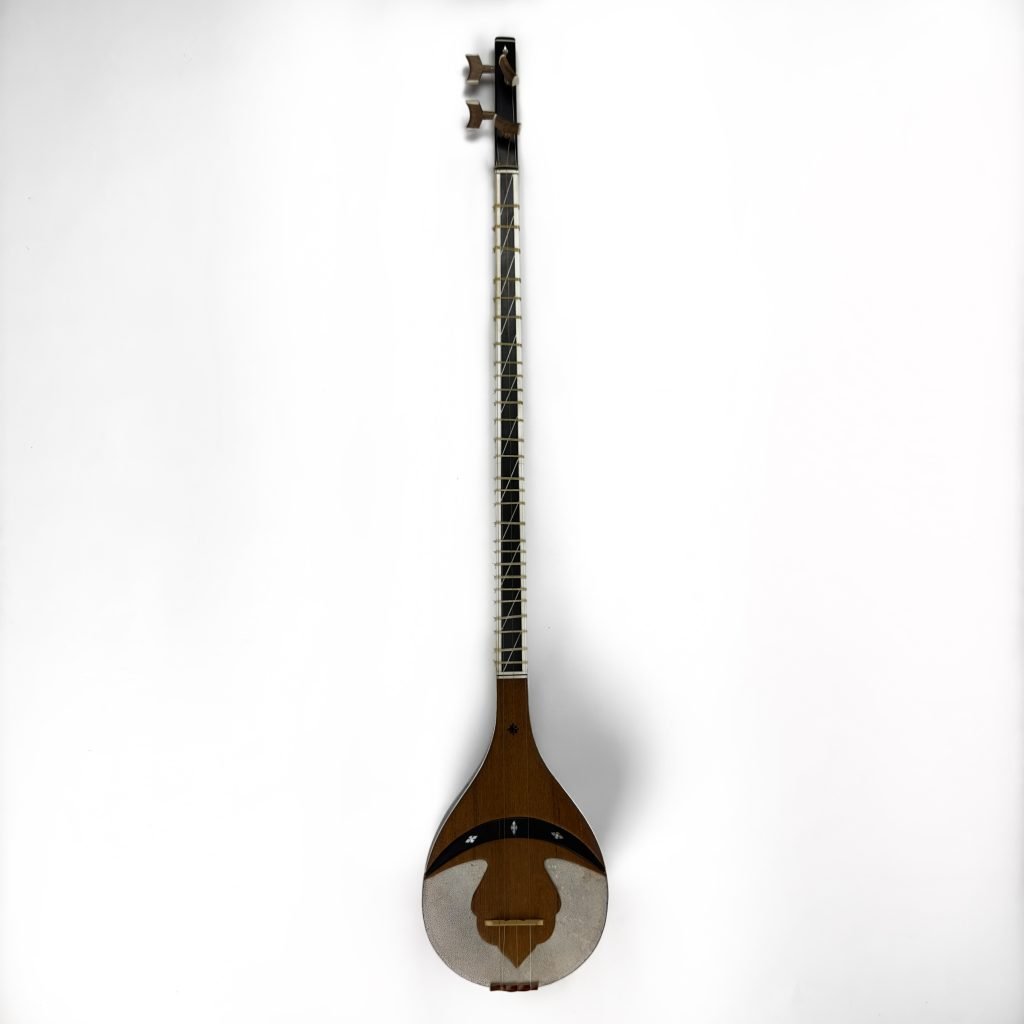
Shurangiz Setar has the softness and the whispering quality of Setar, while it has some characteristics of Tar, like a stronger and more bass sound. The wood top body of the Setar is replaced with the skin body in the Shurangiz Setar. Many Setar players like the fact that they can experience a different tone while still having playability similar to Setar.
- History: The general concept of Shurangiz was initially been suggested by maestro Ali Tajvidi when maestro Ebrahim Ghanbari Mehr designed and made the first Shurangiz. It has been dormant and in silence for a while, when maestro Hosein Alizadeh had the second input to realize it with some ideas for improvement and with the artwork of maestro Majid Ayati.
Shurangiz Setar components:
- Echo box: bowl-shaped echo box of original Setar – usually made of Mulberry wood, but some professional Setars are made of Walnut, Rosewood or Maple wood.
The echo box is made with two techniques: one piece, fully hand carved from a block of wood or ribbed, usually 7-15 ribs bound together.
- Top body: The top body is partly made of thick skin, like goatskin to support the strings load, while making the proper resonance. The half of the top body remains the Mulberry wood, attached to the skin.
- Neck or Fretboard: is about 25 inches or 63 cm in length and is always made of Walnut wood to support a better wear resistance. There might be some decorative parts like bone or shell to make it more attractive aesthetically.
- Frets: There are 25-28 frets and is usually made of sheep guts.
- Strings: 0.2mm Stainless steel (for string #1 and #3), 0.2mm bronze(for string #2) and 0.35mm bronze(for string #4) are the common strings to use. Numbers are from right to left when you have the Shurangiz Setar in front of you.
- Pegs: There are four pegs at the top of the fretboard, where the peg holes are placed.