
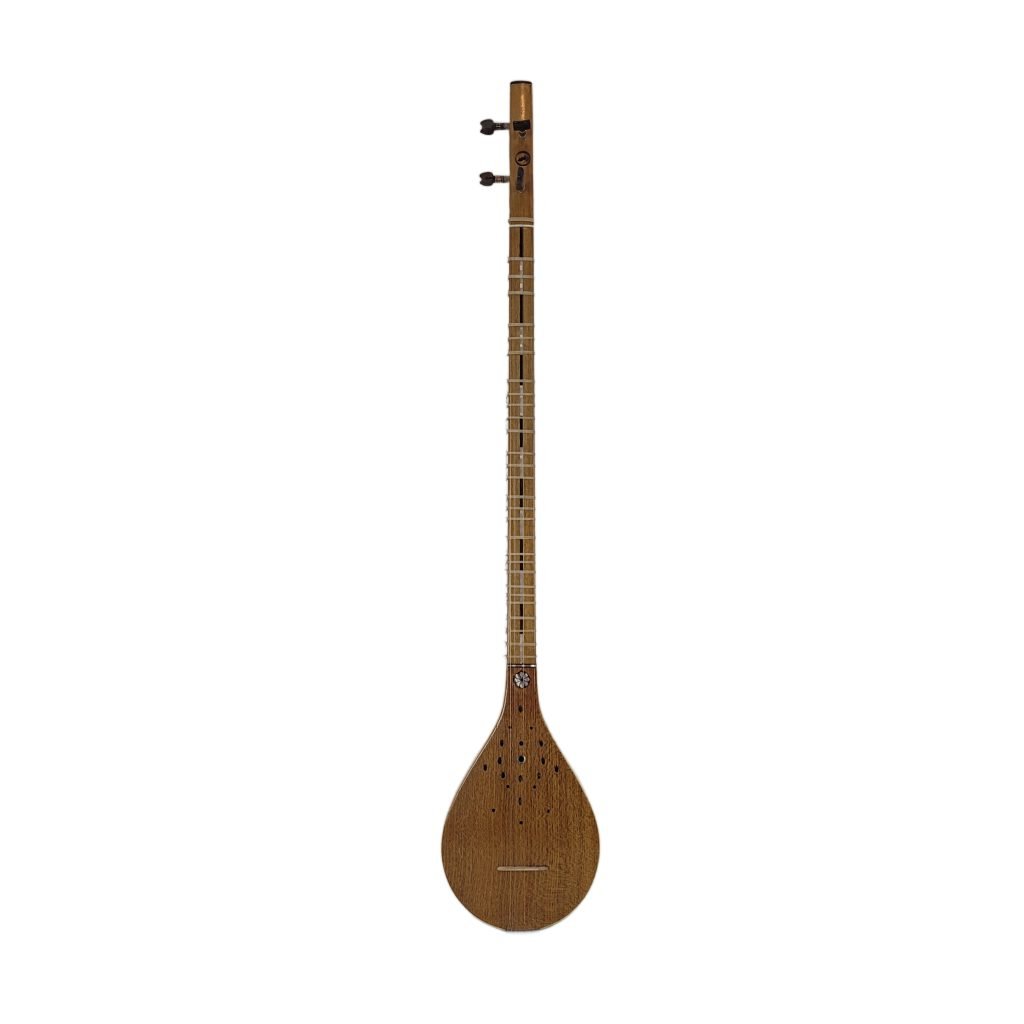
Setar is a spiritual string instrument and a member of the lute family.
Many musicians visualize Setar as a whispering instrument, soft, heartfelt and tranquillizing.
- In the Persian language, “Se” means “three” and “Tar” means “string”, but it has four strings! In the past, it had 3 strings, but over 200 years ago, a Sufi maestro “Dervish Moshtaq Alishah Kermani – died in 1785” added the fourth string to the Setar, to make the sound smoother, while the name remained “Setar” as a spiritual-vintage instrument.
- Setar is played with the right index fingernail and like a guitar – as you have the maximum chance to touch the instrument with both hands and your body, you can express your emotions easier than many other instruments.
- Setar can be played as a solo instrument or accompanied by a vocalist or a band. It has a deep and spiritual sound and nowadays has received fantastic recognition as a beautiful part of fusion bands’ layout.
Setar components:
- Echo box: bowl-shaped echo box – usually made of Mulberry wood, but some professional Setars are made of Walnut, Rosewood or Maple wood.
The echo box is made using three techniques: one piece, fully hand carved from a block of wood or ribbed, usually 7-15 ribs bound together. The last technique is from gourd.
- Top body: is a flat surface, made of Mulberry wood and should have a specific texture and pattern to have the best sound effect, such as sound timber & echo.
- Neck or Fretboard: is about 25 inches or 63 cm in length and is always made of Walnut wood to support a better wear resistance.
- Frets: There are 25-28 frets and is usually made of sheep guts.
- Strings: 0.2mm Stainless steel (for string #1 and #3), 0.2mm bronze(for string #2) and 0.35mm bronze(for string #4) are the common strings to use. The recently added string ( added about 200 years ago) is the string #3. ( numbers are from right to left when you have the Setar in front of you)
- Pegs: There are four pegs at the top of the fretboard, where the peg holes are placed.