

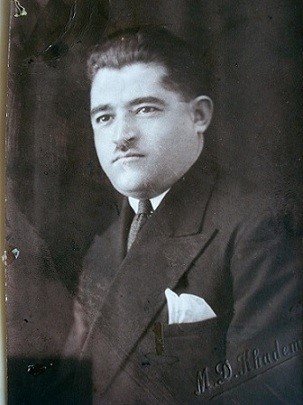
Ramazan Shahrakh (1899-1978)
Ramazan Shahrakh (Ramazanali Shahrakh Soroushi)
Ramazanali Shahrakh Soroushi, known as Ramazan Shahrakh, was a distinguished Iranian instrument maker.
He was born on September 7, 1899, in Tehran and passed away on January 30, 1978, in Tehran.
Shahrakh was primarily renowned for crafting the tar, though he also produced a large number of setars. In smaller quantities, he built tombaks, violins, gheychaks, tanburs, and santurs.
He paid exceptional attention to fine details and aesthetics in instrument making and is credited with inventing the eight-string tar, designed to allow tuning compatibility with Western instruments. He also collaborated closely with Ali-Naqi Vaziri and had teaching experience at the University of Tehran.
Early Life and Career
Shahrakh was born on September 7, 1899, in Mohammadieh Square, Khorasaniha Alley, Tehran.
He lost his mother at the age of two and experienced a difficult childhood under the care of his stepmother. His father, Haj Agha, was a well-known tar maker who initially worked as a carpenter. From early childhood, Shahrakh worked alongside his father.
Around the age of 15 (circa 1914), he learned tar-making in his father’s style but introduced innovations of his own. While his father could produce one tar every three days, Shahrakh later adopted a meticulous method in which each instrument could take up to four years to complete.
The family moved their workshop from Foroughi Street (Filkhaneh) to Amiriyyeh Street and pursued instrument making as their primary profession.
In 1922, Shahrakh opened a two-unit tar workshop in Hasanabad Square, opposite Varzesh Street. That same year, he married Ashraf-ol-Sadat, daughter of Seyyed Ahmad Mir Alinaqi. About 12 years later (circa 1934), they had a daughter named Mahin, his only child. He had no children from his second marriage.
Personality and Character
Shahrakh was known for his compassionate and calm personality. He often bought sparrows or young gazelles and released them in the Darband area.
He strongly avoided conflict and was deeply committed to his work. He is quoted as saying:
“I have never made a bad tar for anyone.”
Around 1961, he ceased the physically demanding work of carving instruments but continued repairing instruments at his shop in Hasanabad until his final years. He would travel daily by bicycle from his home near Park-e Shahr to his workshop.
Despite his innovations, his distinctive style of tar-making did not continue after his death.
Tar Construction Process
Shahrakh carefully selected mulberry trees from orchards in Kan, Evin, and Vanak.
In an interview published on September 29, 1976, he described his process:
- It took over four years to complete one tar
- Wood was soaked in water for three months to remove sap
- Then dried in shade for one year
- Followed by two years of sun drying
- Finally heat-treated to achieve the desired color and durability
Materials used included:
- Walnut wood for the neck and tuning components
- Lambskin for the soundboard
- Ram horn for the bridge and nuts
- Ebony (or Indian hardwood) and camel bone for structural elements
Even minimal warping (as little as 1 mm) would render parts unusable.
Collaboration and Innovations
Shahrakh maintained a close collaboration with Ali-Naqi Vaziri, building custom tar instruments with larger bodies for concert use. These instruments often used gut strings instead of metal strings.
His instruments were produced in three sizes: small, medium, and large, and he would personally fit them to the musician’s physique.
He emphasized that the tar should have eight strings to be compatible with non-Iranian instruments.
Quality Classification
Shahrakh graded his instruments based on quality:
- Three-stamp instruments → highest quality
- Two-stamp, one-stamp, or unstamped → lower grades
Early stamps read “Dast-Ranj Shahrakh” (“Handcrafted by Shahrakh”), later replaced with “Shahrakh” or “Ramazan Shahrakh.”
In later years, he used his photograph as a signature mark on his finest instruments.
Professional Activities
Shahrakh began collaborating with the music school established in 1923, working with Ali-Naqi Vaziri until 1935.
He later taught instrument-making at the Faculty of Fine Arts and continued until his retirement in 1961. After retirement, he occasionally returned to teaching upon invitation.
Illness and Death
From early 1977, Shahrakh was hospitalized multiple times due to liver disease.
He passed away on January 30, 1978, at the age of 79 in Tehran.
He was buried in Behesht-e Zahra, Section 14.
SOURCE:
- Wikipedia (Ramazan Shahrakh)
- Ruhollah Khaleqi, Sargozasht-e Musiqi-ye Iran (The History of Iranian Music), Marvi Publications
- Mahoor Music Quarterly, Issues 51–52
ALL RIGHTS RESERVED © SAZYAR — 2023
WEBSITE DESIGN: STUDIO KOLY