
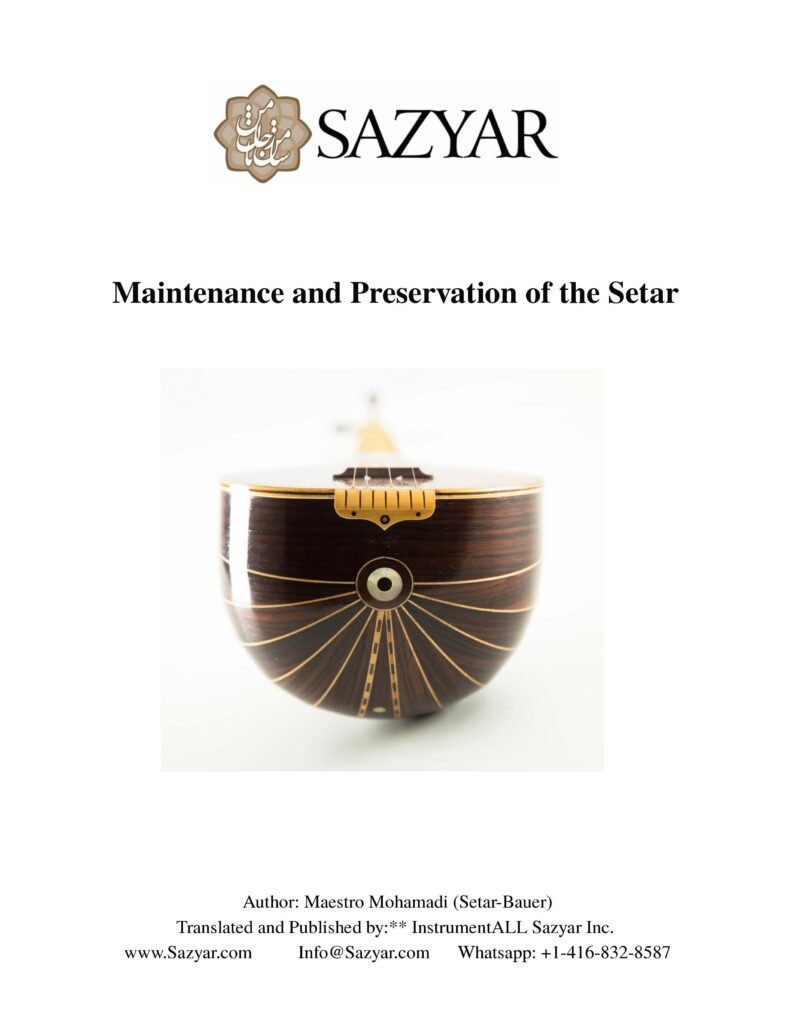
Maintenance and Preservation of the Setar
Introduction
Persian instruments possess unique acoustic qualities and a distinct musical culture, requiring specific conditions for construction, maintenance, and preservation. While some maintenance principles may apply to non-Persian instruments, the specific “tone color” and construction materials of Persian instruments necessitate specialized care.
Persian instruments are unique individuals; it is rare to find two that are exactly alike. Even if a maker constructs one hundred Setars using the same mold, the probability of two being identical is near zero. They may belong to the same family in terms of construction and sound, but the primary material—wood—is a constantly variable factor. Wood differs in its physical and mechanical properties down to the microscopic molecular level. These variations in cellular structure create differences in acoustic properties and how the wood reacts to sound.
Among these instruments, the Setar is particularly delicate. Its most important sonic quality is its “Zang” (Ring/Resonance). A Setar without this ring is considered “muffled,” a significant and often irreparable defect. The primary goal of maintenance is to preserve this specific ringing quality, alongside the instrument’s structural health.
The Nature of Wood
Wood is a natural hygroscopic material. This means it constantly reacts to its environment, attempting to reach an equilibrium with the surrounding humidity.
Equilibrium Moisture Content: The natural moisture content is roughly 12%.
Reaction: If the environment is more humid than the wood, it absorbs moisture; if drier, it releases moisture.
Consequence: This constant absorption and release can cause the wood to change shape or warp. Therefore, musicians must prevent “humidity shocks” by not moving the instrument rapidly between extreme dryness and extreme humidity.
Principles of Maintenance
We have divided the maintenance of the Setar into four main sections:
A. Environmental and Temperature Conditions (Ambient Temperature)
1. Temperature Range: Never leave the Setar in environments with extreme heat or cold, even for a short time. Avoid hot rooms in summer, cold rooms in winter, open air during rain/snow, and especially car trunks. The ideal temperature range is 10°C to 30°C.
2. Air Conditioning: Do not place the instrument in the direct draft of evaporative coolers (swamp coolers), as they blow humid air which can alter the instrument.
3. General Storage: Keep the instrument at normal room temperature, preferably inside its hard case for safety.
4. Stuck Pegs (Humidity): If moved to a humid area, tuning pegs (Goushi) may swell and get stuck. Do not force them by turning, as the necks of the pegs may break. Instead, use a punch-like tool to gently tap the narrow end of the peg (from the back of the headstock) to pop it loose.
5. Sunlight: Never expose the Setar to direct sunlight, even inside its case. Heat can cause the finish to bubble (due to moisture exiting the wood) and warp the structure.
6. Pests (Termites): Avoid storing the Setar near wood furniture infested with termites or borers. These insects can migrate to the instrument.
Detection: Termites often attack the walnut neck (Dasteh) rather than the mulberry bowl (Kaseh), as mulberry is acidic and less attractive to them. Damage often happens internally before tiny external holes appear.
Treatment: If detected early, use naphthalene or aluminum phosphide tablets carefully (Warning: These are toxic). Place 1-2 tablets in a plastic container with holes inside the instrument case for 2-3 days to eliminate the pests.
7. Seasonal Changes: At the turn of seasons, an instrument may sound “off” due to sudden heating/cooling changes in the home. Do not tamper with it immediately; give it time to acclimate to the new conditions.
B. Location and Storage
8. Resting Position: Do not lay the Setar flat on the floor or chairs where it might be stepped on.
9. Vertical Storage: The best position is standing vertically in a corner on a stand, or in a dedicated cupboard. If hanging from a wall, ensure the hook is secure.
10. Heat Sources: Keep away from heaters, fireplaces, and radiators. Continuous heat can warp the neck and soundboard or cause the glued ribs of the bowl to separate.
11. Hanging Precautions: If hanging by the peg box, ensure the pegs are tight. Temperature changes can loosen pegs, causing the instrument to slip off the hook and fall.
12. Surfaces: Do not lean the instrument against rough surfaces (stone, tile) that scratch the bowl. Use a soft pad or a proper stand.
13. Children: Keep out of reach of children or untrained individuals.
14. Transport: Use a hard case with a soft interior (sponge/foam). Avoid plastic bags or sacks.
15. Car Transport: Never put the Setar in the trunk. In accidents, trunks often crush. Place it inside the cabin, secured so it doesn’t fly during braking.
16. Air Travel: Carry the instrument into the cabin. Do not check it into cargo, where pressure and handling will likely break it.
17. Shipping: Avoid standard postal or freight services if possible. Personal transport is safest.
18. Walking: When crossing streets, hold the instrument vertical (perpendicular to your body), not horizontal, to avoid hitting passing cars or obstacles.
19. Case Straps: Check the integrity of case straps and handles regularly to prevent drops.
C. Hand Position and Tuning
20. De-tuning after Play: High tuning exerts immense pressure on the soundboard.
Small/Medium Bowls: Best sounding at B or Bb. If tuned to C or D, tune down to A or Bb after playing.
Large Bowls: More susceptible to soundboard sinking. Best played at A or Bb.
General Rule: For short necks (45-46cm), drop tuning to A. For long necks (48-49cm), drop to G after playing to preserve the soundboard.
21. Fingernails: Keep fingernails on the left hand (fretting hand) short. Long nails scratch the wood behind the frets. These gouges are unsightly and can cause notes to sound false (out of tune) or buzzy.
Technique: Use the fleshy pad of the fingertip, playing with fingers slightly angled to avoid nail contact.
D. Repairs (Reparation)
22. Do not use random glue: Never use standard wood glue or superglue for DIY repairs. Setar making requires specific glues (often hide glue) so that the instrument can be opened for future repairs.
23. Consult a Professional: If the bowl cracks or the neck warps, take it to a professional maker. Amateur repairs often cause irreversible damage.
24. Bridge (Kharak) Position: The position of the bridge is critical for intonation. If it moves, the scale length changes, and notes will be out of tune. Mark the correct position carefully if you must change strings.
25. Frets (Pardeh): Gut frets wear out over time. If they become loose or unravel, they must be replaced by a skilled person to ensure the correct micro-tonal intervals are maintained.
References
1. Mahoor Music Quarterly, No. 1, Autumn 1998, “In Memory of Master Kamalian”, Hamid Sokouti, p. 188.
2. Tradition and Modernity in Persian Music*, Jean During, trans. Soudabeh Fazeli, Toos Pub., 2004, p. 58.
3. Wood Technology, Dr. Davoud Parsapajouh, Tehran University Press, 6th Ed., 2005.
4. The Art of Persian Music, Jean During, Zia Mirabdolbaghi, Mega Publishers, 1991.